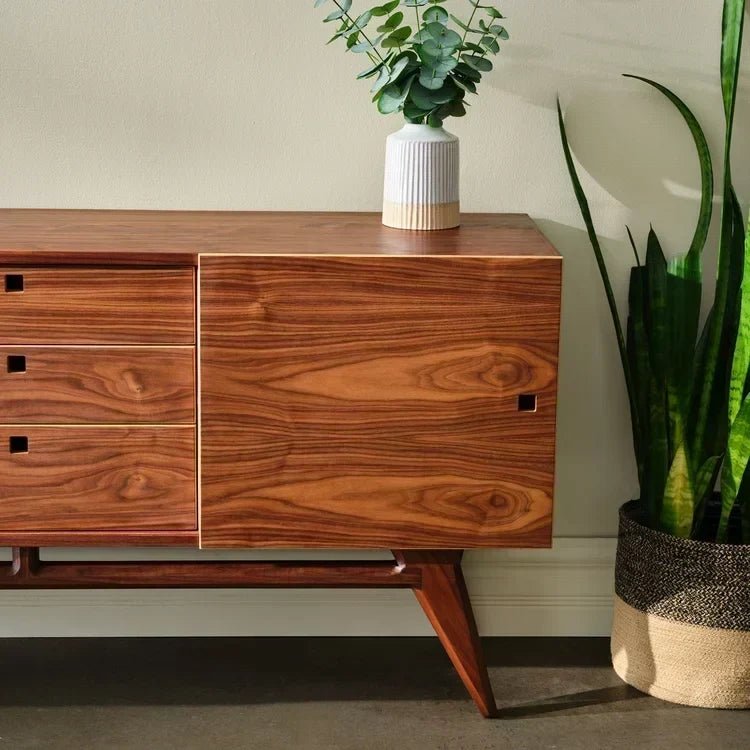
I’ve been decorating my home in a mid-century modern style for as long as I can remember, and what I’ve learned over time is that it comes down to a handful of consistent principles — natural materials, clean lines, functional forms, calming colors and thoughtfully considered pieces instead of mass-produced ones. Get these right and the style holds together in almost any room. This is a room-by-room guide to actually doing it — for the history of where the style came from, I’ve written about that separately.

The Living Room: Where MCM Does Its Best Work
The living room provides the most accessible place to start your mid-century modern styling. Seating, storage, decorating surfaces and accent pieces all apply here, so it’s the natural place to begin. There’s a simple rule that carries through every piece in this room (and all rooms): it should take up only the space it needs, nothing more.
Seating. Sofas and accent chairs are the foundation of this room. Stick to low-profiles, tapered legs and proportions that meet the room’s needs but don’t exceed it. Be wary of pieces that are overstuffed or unnecessarily ornate. Organic shapes and warm toned upholstery — cotton, wool, leather, velvet — pair well with a wood frame underneath. Keeping the structure of the furniture visible does a lot of the work on its own: when the frame disappears under the upholstery, a chair starts reading more like a recliner than a mid-century piece. While I generally stick to neutral colors, for a focus piece it’s ok to add in muted, earthy colors. These colors feel grounded and calming, but steer clear of bright primary colors and soft pastels, which can add an unwanted energy and vibe to the space.
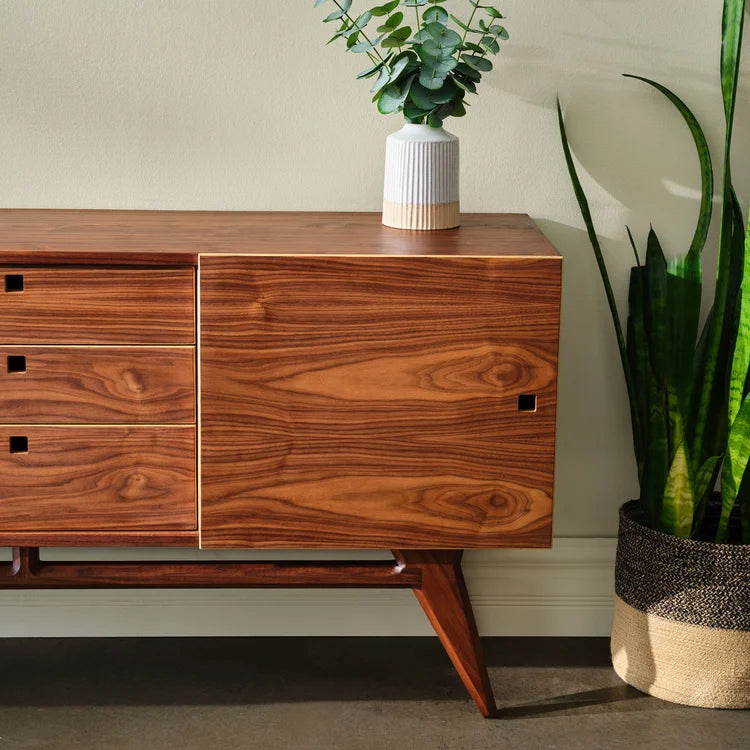
The Console. Storage in an MCM living room is as much about function as it is about display. A media console with clean lines and integrated hardware anchors a room without making it feel cluttered, and a good one gives you a spot for everything you actually use and closed storage for everything you don’t need to look at. Clutter is the enemy of MCM styling, so being able to hide away anything not needed in a design-forward way is a win. The signature media console in my collection features ample storage, simple and clean geometric lines and one focal element throughout — the Baltic birch stripes. I use the striped pattern of the birch layers to create sculptural legs as well as sliding doors that nest over one another to create a wood lattice pattern.
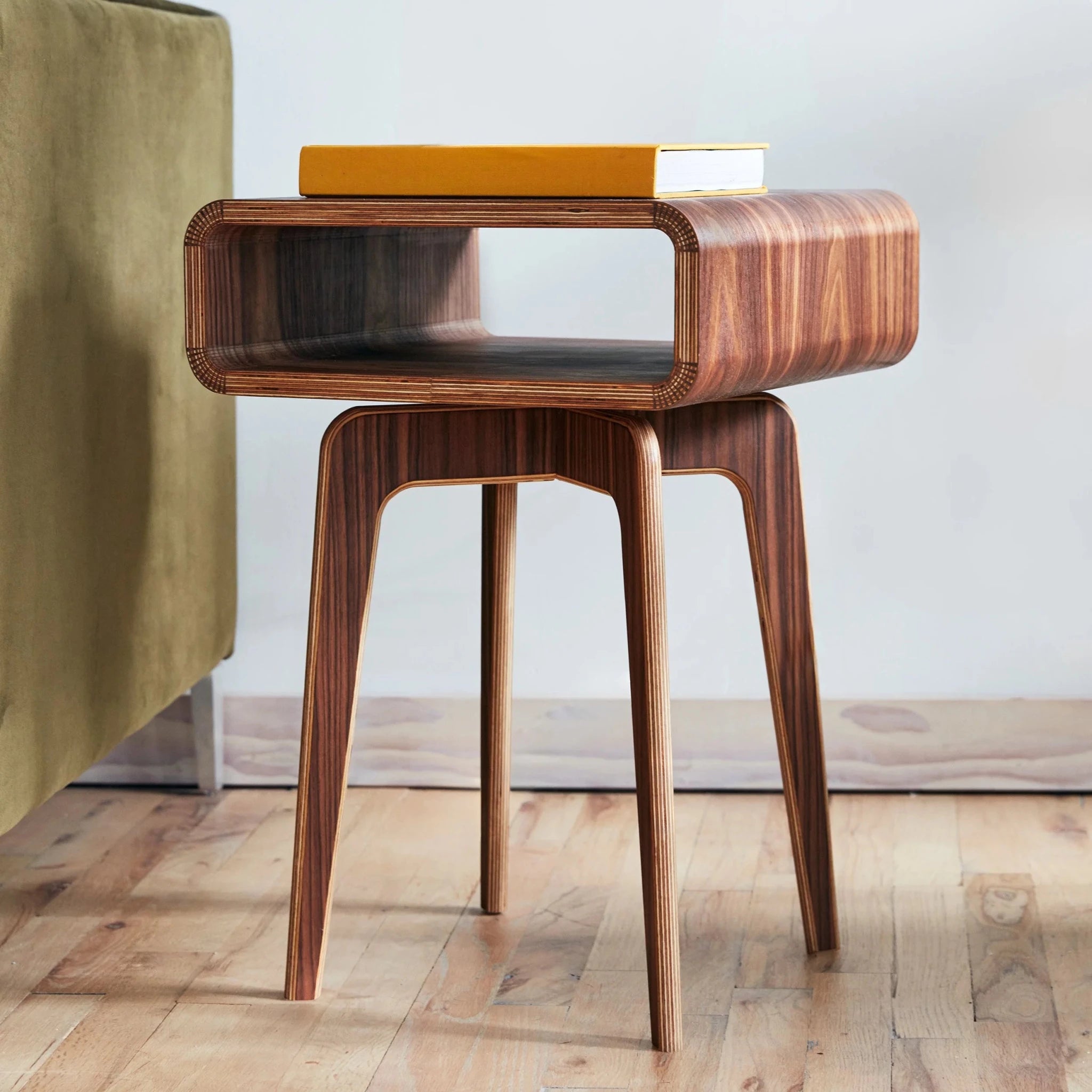
Coffee and End Tables. There’s nothing more mid-century modern than a wood coffee table or end table with tapered legs and a simple silhouette. These pieces should feel visually light even when they’re solidly built, and the way this is achieved is almost always with the legs, not the top. Scale it to the room, too — a small coffee table in front of a large sofa feels like an afterthought, and a large, tall coffee table in a small living room screams big-box-store. Note that many MCM coffee table and end table designs will likely feel lower in height than you’re used to. Embrace it and you’ll notice a difference.
The Wall Clock. A large wood wall clock is an easy way to bring MCM character into a living room without a large investment — the clock I create runs $184 (as of summer 2026). That’s about as low a bar as this style has for changing a wall’s look. Seek out clean geometric faces, natural wood or metal surrounds and hardware you barely notice.
There are also plenty of “famous” MCM wall clocks out there — knock-offs, reproductions and real vintage pieces, more varieties than you’d expect. Personally, I stay away from pieces that look too “atomic.” My feeling is that leaning into that style of MCM can feel cliché instead of genuine. Remember — a main pillar of this design style is to create a calm and minimalist environment. Throw in too much flair or whimsy and the opposite happens.
The Bookcase. Open shelving with quality wood construction gives a living room somewhere to display books and objects without adding visual bulk. A geometric bookcase adds structure without competing with everything else in the room.
When styling a bookcase, focus on the negative space as much as you do the items you put on it. Overfilling a bookcase can take a calm, open environment to cramped and suffocating very quickly. Try playing with how books are displayed and don’t only rely on the traditional library shelving arrangements. Maybe stack a few on their sides for variation.
A few more styling tips include leaving some shelves empty, not letting the top of the bookcase overflow with decor and adding sculptural pieces onto the bookcase shelving.
Lighting. A carefully chosen lamp can alter the feeling of a room more than any other element. With a ceramic or wood base and a linen drum shade, a simple table lamp can work in almost all MCM rooms. Choose warm white bulbs (2700 to 3000 Kelvin) over cooler, bluer light, which fights with warm wood tones instead of complementing them. One of the most classic ways to use lighting is with an arc floor lamp positioned over a seating area, or a paper-shaded lamp in the Noguchi tradition. Look for lighting that doubles as a sculptural object, not just a light source — that’s as true to the style as any piece of furniture in the room.
Windows. Keep it minimal here — simple wood blinds, woven shades or linen panels that let the light in rather than block it out are the way to go. Heavy drapery (especially patterned) works against the style. This is advisable in every room of the house, because natural light is as much a part of MCM as the furniture is.
Accents. I’ll talk more about this later in the Finishing Touches section, but in general, keep the decor intentional and sparse. Don’t overcrowd walls, and don’t pile decor onto the console. A few meaningful pieces go a long way.

The Bedroom: Warm, Spare and Intentional
MCM style is all about restraint, and the bedroom is a perfect place to practice this. A low platform bed frame, reasonably sized nightstands and warm wood tones not only keep a bedroom simple, calming and beautiful, but also make it a good place for resting and waking refreshed.
The bed frame. A low-profile bed frame with tapered legs sets the tone for the whole room. It should feel grounded, not decorative. The frame is doing structural work, not performing. The bedding material should feel natural and comfortable. Overstuffed duvets aren’t going to cut it here. While I prefer solid colors for bedding, a bold but muted color or pattern could be used for the bedspread to create a focal point in the room.
Nightstands. A pair of matching nightstands with simple drawer pulls does more work than you’d think. Function matters here too — there should be room for a lamp, a book and whatever you actually keep by the bed, but a nightstand that doubles as a dining room table just invites clutter. When you limit the size, you limit what piles up on it. The form should feel simple, calming and not overly ornate.
Accents. A plant stand with a tall potted plant in the corner to bring in a bit of the outside, a sculptural object on the dresser or a quiet wall hanging adds character without cluttering the room. The bedroom doesn’t need more than a couple of these — that’s kind of the point.

The Dining Room and Bar: Function as a Design Statement
MCM dining rooms are quiet and focused, meant for sharing a meal and not housing a large collection of [insert cliché here]. A well-built table, simple seating and one or two well-chosen accents are enough. Remember, it’s almost always function and beauty working together, not one instead of the other. Anything more and it loses its focus.
The Dining Table and Chairs. Natural wood top, simple lines and legs that taper or square off cleanly fit the bill for most dining rooms. The table is the centerpiece of the room and should be able to stand on its own without a lot of styling around it. Metal legs are another great option, having become quite popular in recent years. For seating, don’t feel like you need a matching set. Contrasting the wood table with molded plastic chairs is a popular, attractive and often affordable way to make your dining room stand out.
The Liquor Cabinet and Bar. A mid-century modern liquor cabinet is one of the most distinctive pieces you can add to a room. Choose a piece with reasonable proportions, clean lines and a design built around display as much as storage. On the outside, it should feel simple and calm, while on the inside, it should have ample storage to keep a collection of spirits organized. An ideal liquor cabinet will have room for a decanter, a bar tray and a beautiful vase on top.
Accents. A wall clock works well in a dining space too, especially in open-plan layouts where the living and dining areas share a wall. For other wall hangings, aim for one or two large pieces. Don’t fill the walls with an overwhelming number of different pieces. Similarly, a rug under the table anchors the space as well — look for geometric or abstract patterns over anything busy or floral, and size up more than you think you need to; a rug that’s too small makes the whole room feel smaller. The same logic holds in any room you put one: it should ground the furniture, not compete with it.

Finishing Touches: MCM Accents That Pull a Room Together
Designing your space in an MCM style is about much more than just furniture — the objects you choose, and how you display them, are what separate a room that feels curated from one that just has nice pieces sitting in it.
Decor. I swear by a few basic rules when it comes to styling my home in an MCM way.
First, all pieces need to be intentional. Whether it’s a vintage item, an object from the natural world or a piece by an original artist, it needs to mean something to me and my family. Random objects that are mass-produced for home stores have no place in my home.
Second, color choices should rely heavily on muted, earthy colors. Think mustard yellow, burnt orange, avocado green, warm cream. Bright primary colors and pastels don’t play as well in a mid-century modern home. Think of colors as a way to boldly ground a room.
Third, decorate sparingly. As mentioned earlier, bookcases can have empty shelves. Walls don’t need to be completely covered with art. The media console doesn’t need decor on each end and in the center. The coffee table probably needs nothing more than a tray or low-profile bowl.
Fourth, arrange in odd numbers and off-center groupings. A pair of matching objects centered on a shelf reads as staged. Three pieces of different heights, clustered to one side, read as considered. MCM styling rarely centers anything.
Fifth, and most importantly, let the room come together slowly. Buying everything at once can lead to a home feeling like a showroom. Pieces that actually mean something usually get added one at a time, as you find them.
To do this in a straightforward way, limit what decor you invite in. Only open the door for items from family trips, original art that you’ve fallen in love with, items you’ve found in nature or vintage pieces passed down through the family. Every piece in my home has some sort of meaning and memory behind it (and that memory isn’t ever me walking down the aisle of a home decorating store and saying “ooh, that’s pretty!”)
Plant stands. Plants and natural elements are a great way to embrace some of the main tenets of MCM style, and a wood plant stand for your potted plant, with slim, angled legs, brings warmth and organic shape to any room. A tall stand in a corner, or two stands set at different heights, does more than a potted plant sitting straight on the floor.
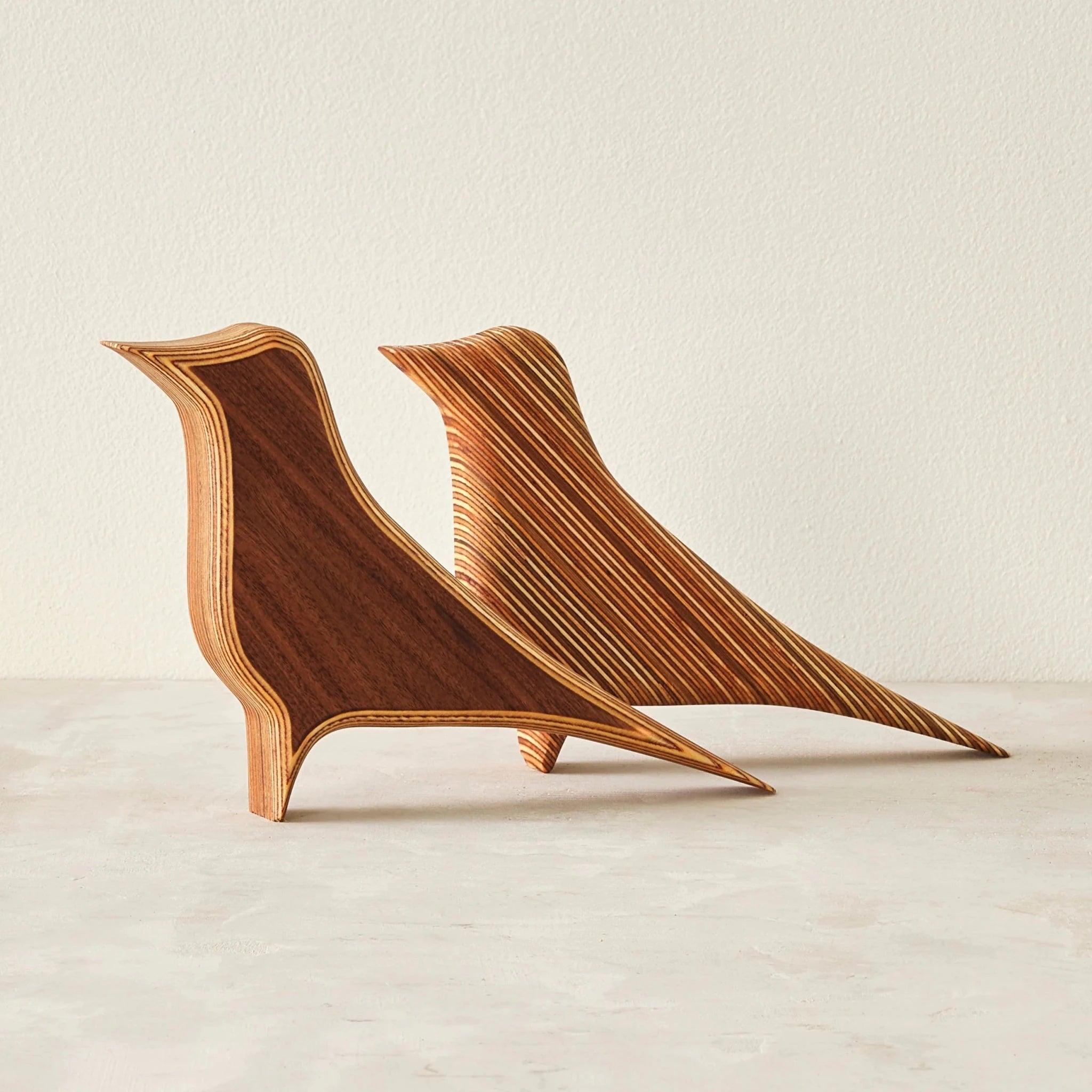
Bookends. Natural wood or stone bookends on open shelving add structure and warmth. They work equally well in a living room, a bedroom or a home office.
Sculptural objects. Sculptural pieces are a defining element of MCM interiors — look for organic forms, natural finishes and pieces made from real materials (wood, metal, stone) rather than resin or plastic cast to look like something real. A browse through smaller accent pieces is a good place to start if you’re not sure where to begin.
Classic games. A chess and checkers set or another classic game on a coffee table or shelf is both functional and decorative. It signals the kind of home where things are made to be used, not just looked at.
What Makes It Feel Authentic
Strip away the specific pieces and a few ideals hold the whole style together: real materials — wood, stone, metal, glass — over anything made to imitate them; clean structural lines, tapered legs among them; warm, earthy tones over anything too bright or too pastel; and restraint in styling, meaning fewer pieces and more room to breathe. If you want to know exactly how to tell real materials from imitations, I've written a whole guide to spotting quality construction. For lighting overhead — a sculptural pendant, a globe fixture or a sputnik-style chandelier does more for a room than a flush-mount light that feels like an afterthought, no matter which room it’s in.
The best MCM rooms usually mix handcrafted or made-to-order pieces with actual vintage finds, rather than filling a room entirely with either one.
None of this requires overhauling a house all at once. Pick the room you’re in most, start with one anchor piece and build out from there — the restraint is as much a part of the style as what you build it with.
— Justin, Relic Modern
Frequently Asked Questions
- What are the key design elements of mid-century modern decor? Natural wood tones, tapered legs, clean and functional lines, organic shapes and a general lack of ornamentation. Rooms tend to feel curated rather than filled.
- How do I decorate a room in mid-century modern style? Start with one or two anchor pieces — seating and a media console in a living room, a bed frame and nightstands in a bedroom — then add warmth with wood tones, muted colors and one or two sculptural accents. Restraint matters as much as the pieces themselves.
- What is mid-century modern decor, exactly? A decorating approach built around natural materials, simple geometric forms and furniture that’s functional first. It favors real wood, metal or stone and clean construction over ornamentation or trend-driven pieces.
- Do I need matching furniture for mid-century modern style? No — complementary is better than matching. Consistent leg shapes do more to tie a room together than exact wood matches; the trick with mixing tones is undertone, not species — keep everything either warm or cool, and walnut, oak and teak can sit together just fine.
- Is mid-century modern interior design just about the furniture? Furniture is the fastest way in, but full interior design also means wall color, lighting and how much you leave open. Mid-century modern home furniture does most of the work; restraint in everything around it does the rest.
-
How should I light a mid-century modern room? Layer it — a sculptural overhead fixture, plus a floor or table lamp at seating height, rather than one bright overhead light doing all the work. Stick to warm bulbs and let the fixtures themselves double as decor, not just light sources.